
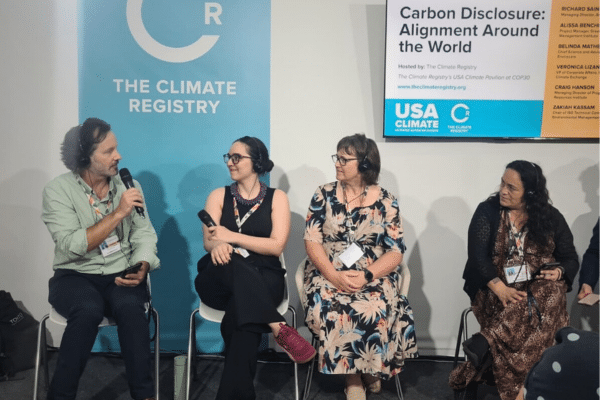
 At COP30 in Belém, Brazil, a packed audience at the USA Climate Pavilion gathered for a panel on one of the thorniest topics in climate action today: how to align carbon disclosure rules around the world.
The session, “Carbon Disclosure: Alignment around the World,” hosted by The Climate Registry, brought together experts from standard-setters, certification bodies, exchanges, and capacity-building organizations. On stage among them was Alissa Benchimol, Project Manager at the Greenhouse Gas Management Institute (GHGMI), who used the moment to make a clear call: This is a once-in-a-generation chance to raise the bar on greenhouse gas accounting—and we can’t afford to waste it.
Harmonization is here. Now we need rigor.
The panel opened with a theme that’s been echoing across COPs and climate fora: harmonization of carbon disclosure. With the Greenhouse Gas Protocol (GHG Protocol) and ISO now formally partnering to align standards, there is genuine optimism that companies and governments may soon have a more coherent rulebook to work from.
For Alissa, that alignment is welcome—but not enough on its own. Representing GHGMI, she reminded the room that harmonization only delivers real climate value if it’s matched with stronger technical rigor and expert involvement:
“In the harmonization challenges and what we expect in the future ahead is to continue to have proper expertise in the rooms and the decision making… and join the expert panels and expert working groups of the revision process.”
She described this moment as “a very key and amazing” opportunity that climate professionals have been waiting for—especially those who have struggled for years with ambiguities in existing guidance.
“Anyone who’s been struggling with the Protocol’s not-so-specific guidance has been for years begging for opening of the Protocol… to get some changes that are more actionable and implementable and actually result in proper foundation inventory for meaningful target setting.”
Not starting from scratch–but we could get stuck for another 20 years
Alissa emphasized that the current revision of the GHG Protocol is fundamentally different from the early 2000s, when the first corporate standard was published:
“The most amazing thing… is that we’re not starting from scratch anymore. When the Protocol came out in 2004, it was the first one. They did amazing work to get us to the space, [where] we know what Scope 1, 2, and 3 even mean.”
She noted that those once-technical terms are now embedded in legislation across the world, such as California’s climate disclosure law. But that success comes with a new risk: whatever is agreed now could lock in practice for another 20 years.
“This revision round might be for another 20 years that we have the same Protocol… and we can’t get it wrong this time or have anything that does not lean on proper accounting for climate action.”
Her message to the room was urgent but constructive: the revision is a huge opportunity—but the window of time to influence it is short.
A profession growing up fast
One of the strongest threads in Alissa’s comments was the professionalization of GHG accounting itself.
As a Project Manager at GHGMI, she works across corporate and national GHG accounting, MRV capacity building, data systems, and program implementation—and sees the skills gap firsthand. For her, alignment of standards has to be matched by training and certifying the people who will implement them.
“At the Institute, it’s teaching, teaching, teaching, building capacity. Here are free resources for you and the community, and us, continuing to learn… No one knows every industry-specific scenario, and the technical working group needs to hear from every practitioner.”
She underscored that GHGMI’s approach is to train individual professionals who then move across roles—working in companies, software firms, governments, and verifiers—carrying good practice with them wherever they go.
“It is really training the individual… who can work at a company, work at a software company doing reporting, or work on a national inventory. It’s really important to go to the individual level and train on what rigorous greenhouse gas accounting means.”
Alissa also highlighted that GHG accounting is becoming a defined profession and noted GHGMI’s work on a professional certification program to further standardize skills and competencies.
Her point landed so strongly that fellow panelist Craig Hanson drew a comparison: financial accounting took roughly 400–500 years to become the profession it is today; carbon accounting has come astonishingly far in just a few decades. The work that GHGMI and others are doing is helping it “grow up” quickly.
From cross-sector flexibility to sector-specific clarity
Another major theme in Alissa’s interventions: the era of purely cross-sector, highly flexible guidance needs to evolve.
She acknowledged that the original GHG Protocol was intentionally cross-sector and flexible to bring as many organizations on board as possible. That flexibility achieved its goal—widespread awareness and adoption—but it also created inconsistency and vagueness:
“For the longest time, GHGP has always been flexible because they were moving the mass of organizations to get here, and they did. They accomplished this. And now we’re here having those urgent conversations for data that supports meaningful climate action.”
Her “plea,” as she put it, to standards bodies like the GHG Protocol and ISO was to open the door to more sector-specific guidance:
“At the Institute, we really believe in sector-specific inventories to address what a sector’s issues and emissions-intensity activities are… The more we expand the door of a cross-sectoral standard and don’t give guidance to what a future sector-specific standard would look like… the more people don’t know what they’re responding to.”
She argued that the next generation of standards must provide direct language on how sector guidance fits inside a common framework, so that flexibility doesn’t become confusion—and so that transparency and consistency are preserved.
Her “magic wand” wish: separate inventories for footprint and action
In one of the final questions, panelists were asked to imagine sitting at a future COP and looking back: if they were successful, what would have changed in two years?
Alissa’s answer went straight to the heart of current debates about whether and how to account for climate actions, carbon markets, and contributions beyond a company’s own footprint.
Her “magic wand” vision:
“We are officially splitting physical [allocational] greenhouse gas inventory with an action-based [contribution] inventory. Companies have the opportunity to do credible, reputable, and rigorous climate action, and get measured and recognized for it—and no more room for questionable actions and misleading physical inventories.”
In her view, separating a core emissions inventory from a contribution inventory would allow companies to be measured and recognized for robust climate actions without blurring the line between “emissions footprint” and “contributions beyond the value chain.”
She imagined a future where the conversation among companies is no longer about how to creatively stretch accounting rules, but about learning from one another’s credible actions:
“Maybe the questions two years from now… are companies talking: ‘What are you doing that I can do as well?’ Because we don’t want to be in bad waters anymore. We want to take the proper action.”
A bigger story: harmonization only works if people are ready
Throughout the panel, other speakers highlighted landmark developments such as the GHG Protocol–ISO partnership, the use of ISO verification standards in legislation, and the growing role of regional contexts—from Latin America’s land-use emissions profile to New Zealand’s largely decarbonized electricity sector.
Alissa’s interventions tied those threads together around a simple truth:
Harmonized standards do matter.
But they only deliver real climate impact if professionals are trained, systems are built, and sector-specific realities are addressed.
From her vantage point at GHGMI—working on software evaluations, national MRV systems, IPPU and waste sectors, F-gases, and corporate accounting tools—she sees both the urgency and the opportunity of this moment.
“We don’t have much time… I really hope everyone here, with your peers, engage, comment, send comments, so we can make sure that this next round… results in proper accounting for climate action.”
Watch the panel
Click the link below to watch the full recording of “Carbon Disclosure: Alignment around the World”—with Alissa Benchimol and fellow experts.
Comments