
 In climate policy, so much work goes into passing a law that it can often feel like the finish line. In reality, it’s usually the beginning. The end goal is set, and now the work to reach it begins. And that’s exactly the case in Uganda.
Over the past decade, Uganda has quietly built one of the more comprehensive climate governance frameworks in East Africa. The country adopted a National Climate Change Policy in 2015, submitted an updated Nationally Determined Contribution (NDC) under the Paris Agreement, and, in 2021, enacted a Climate Change Act that established a legal foundation for national climate action.
These are undoubtedly significant achievements, yet climate action isn’t measured by policies alone. It’s measured by what happens after they are adopted and whether institutions can collect the right data, ministries can coordinate their efforts, progress can be tracked, and governments can demonstrate that commitments are translating into real-world outcomes. That’s the story unfolding in Uganda today.
Climate Ambition Meets Implementation
Uganda faces a complex climate future. Agriculture remains central to the economy and livelihoods, while changing rainfall patterns, rising temperatures, droughts, floods, and ecosystem degradation are already affecting communities across the country. Uganda’s population continues to grow rapidly, increasing demand for land, energy, infrastructure, and natural resources. At the same time, the country has committed to reducing greenhouse gas (GHG) emissions and strengthening resilience to climate impacts.
The Next Phase of Uganda’s Climate Journey
Uganda’s second engagement under the Initiative for Climate Action Transparency (ICAT) is underway, a partnership designed to help countries strengthen the transparency and accountability systems that underpin climate action.
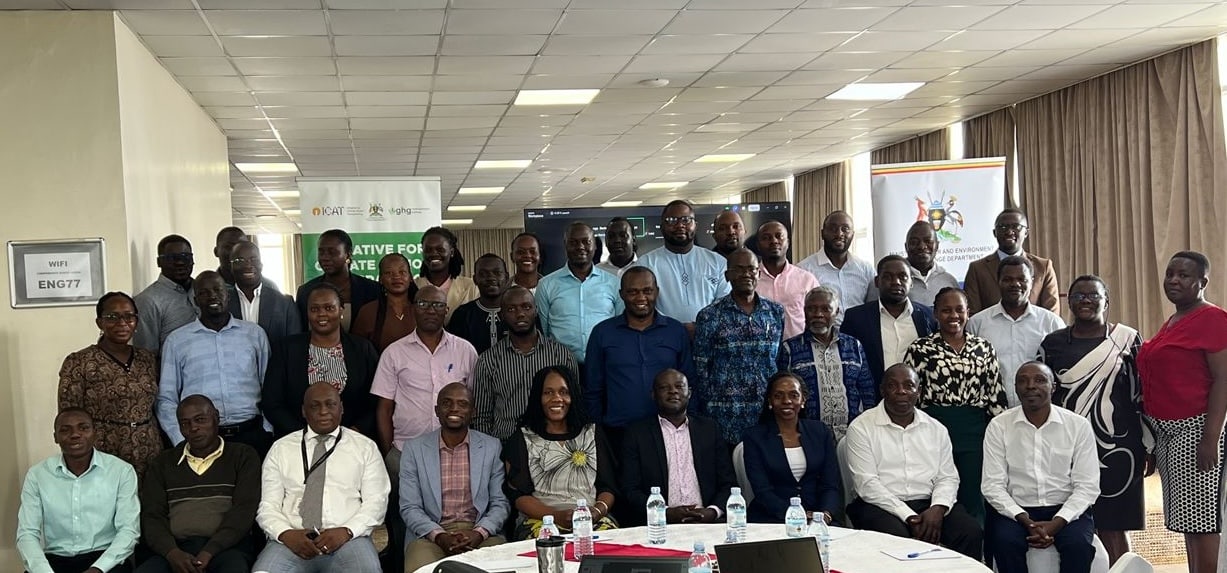
On 7 May 2026, representatives from Uganda’s Climate Change Department, sector ministries, technical experts, ICAT, and the Greenhouse Gas Management Institute (GHGMI) gathered in Kampala for the project’s inception workshop. More than a project kickoff, the workshop marked the beginning of a new phase in Uganda’s efforts to operationalize its Climate Change Act and strengthen the systems needed to track progress toward its climate commitments.
GHGMI’s consortium, serving as ICAT’s implementing technical partner, is supporting Uganda’s Climate Change Department in a new phase of work that focuses on two closely connected goals. The first is expanding Uganda’s ability to track progress on its NDC commitments across key sectors, including energy, agriculture, forestry, and industrial processes. The second is developing the regulatory framework needed to operationalize the Climate Change Act.
Taken together, these efforts address a fundamental question: how does a country move from climate ambition to climate implementation?
Why Climate Governance Happens Behind the Scenes
The answer to the question above is often found in places that receive little public attention, such as the procedures governing the collection of emissions data, the frameworks enabling ministries to report consistently, and the institutional arrangements clarifying responsibilities and creating accountability. These technical foundations rarely generate headlines, but without them, climate policy remains difficult to implement and even harder to evaluate.
Uganda’s experience reflects a broader shift taking place internationally. As countries move beyond announcing climate targets, attention is increasingly turning toward the institutions and systems required to deliver them. The focus is no longer solely on what governments promise to do, but on how they will demonstrate progress. In many respects, Uganda’s ICAT journey mirrors that evolution.
The first phase of support concentrated on strengthening GHG inventories, emissions projections, and NDC tracking in the transport and waste sectors. That work laid important foundations and revealed a broader opportunity to expand climate-tracking systems across the rest of the economy and create stronger links among technical reporting, policymaking, and implementation. Phase II builds on that momentum.
From Reporting Requirements to Better Decision-Making
The second phase of our work in Uganda focuses on objectives that may sound technical—developing tracking frameworks, data collection templates, and regulatory procedures—but their significance is practical. Better information helps decision-makers understand whether policies are working, and clearer regulations help institutions fulfill their mandates. Additionally, more robust reporting systems support domestic planning and help Uganda meet its international obligations under the Paris Agreement‘s Enhanced Transparency Framework (ETF).
Perhaps most importantly, these systems create continuity. Climate action extends across election cycles, development plans, and institutional changes. Strong governance frameworks ensure that progress does not depend solely on individual projects or champions but becomes embedded within government systems.
Uganda’s Next Chapter in Climate Action
All mentioned above is exactly why this moment matters. The story of climate action in Uganda is not simply about emissions reductions or reporting requirements; it’s about the gradual construction of the institutions needed to govern a changing climate. It’s also about building the capacity to understand what’s happening, measure what matters, and make better decisions over time. The Climate Change Act established the destination, and now the work underway is helping chart the path to get there.
And while much of that work happens behind the scenes—in workshops, technical consultations, regulatory drafting sessions, and data systems—it represents one of the most consequential stages of climate action: turning commitments into capability. For Uganda, that next chapter has already begun.
Comments