
 Nigeria’s NDC 3.0 sets an economy-wide goal of cutting emissions by 29% by 2030 and 32% by 2035, compared with 2018 levels. On paper, that ambition comes down to a reduction of 184.9 million tonnes of carbon dioxide equivalent (Mt CO₂e) in 2035. In practice, the people responsible for delivering it will spend the next decade watching significantly different numbers: how many electric and compressed natural gas (CNG) vehicles are on the road, how many hectares of forest are restored, and how many households have switched to cleaner cooking fuels.
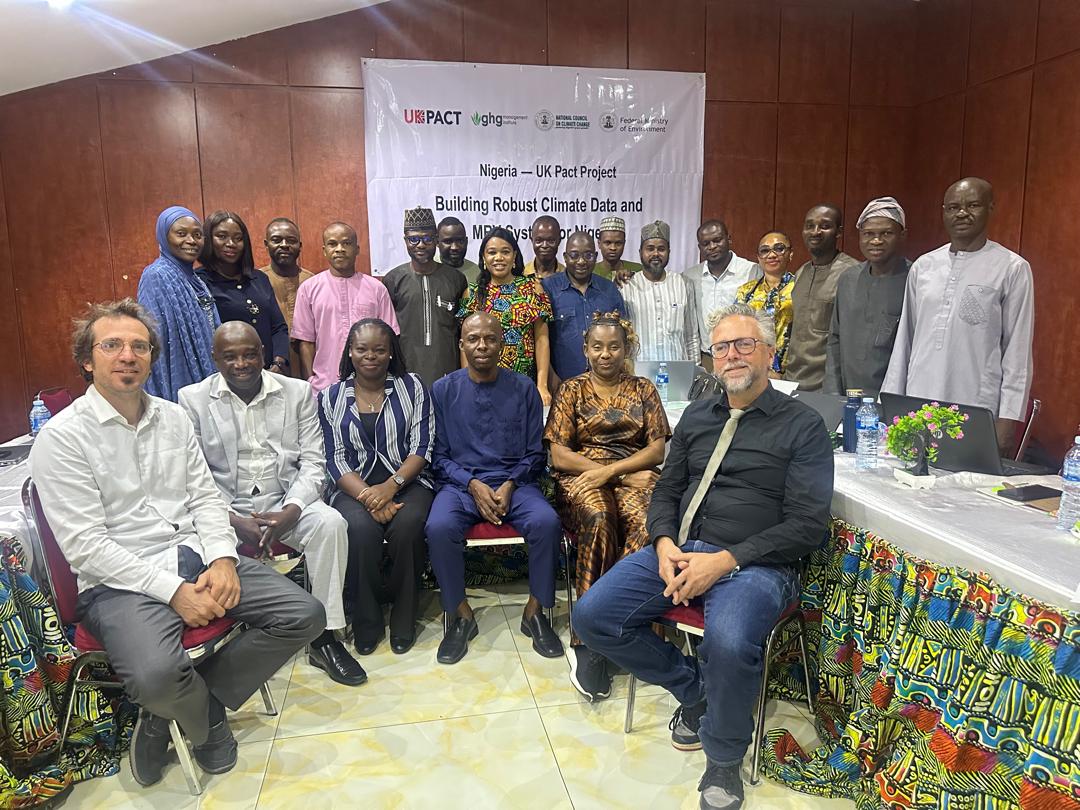
And that’s what the latest stage of the Nigeria–UK PACT project, Building Robust Climate Data and MRV Systems for Nigeria, focused on. Hosted by Nigeria’s National Council on Climate Change (NCCC) and funded by UK PACT (Partnering for Accelerated Climate Transitions), the training began with two preparatory webinars on October 8 and 12 and continued with a four-day, in-person workshop in Abuja from October 19 to 22. It built on the alignment work that started at the project’s inception workshop in February.
From Tonnes to What You Can Count
Nigeria’s NDC 3.0 includes 24 mitigation measures across five sectors: energy; industrial processes and product use (IPPU); agriculture; land use, land-use change, and forestry (LULUCF); and waste. About two-thirds of the country’s expected impact in 2035 comes from one measure: expanding Nigeria’s forest sinks and slowing deforestation. Much of the rest comes from measures on clean vehicles, oil and gas methane, bus rapid transit, and low-emission refrigerants.
In the NDC tracking sessions led by GHGMI, participants started with the simple equation behind every emissions estimate: Emissions = Activity data × Emission factor. Both the activity data and emissions factors are needed—but policy can only cut emissions by changing one of them. So to track a policy, you follow the activity it’s meant to change.
Take the NDC’s goal for 30% of Nigeria’s car and truck fleet to run on electricity by 2035. To plan and track it, a ministry needs to know:
- 30% of which fleet
- how many new electric vehicles that means each year
- how many chargers need to be in place, and
- what happens to the cars being replaced.
Seeing the vehicle counts, budgets, and timelines behind a projected reduction lets decision-makers test whether it’s realistic and plan the steps to get there. Trainers also encouraged participants to track counts over percentages whenever possible. A percentage can shift if the top number changes, the bottom number changes, or both, and each situation calls for a different response. Therefore, tracking actual counts delivers more reliable results.
Putting Real Data into Real Systems
The workshop ran on two parallel tracks, each built around a platform set up for Nigeria:
- GHG inventory track, led by Citepa (the French technical reference center that compiles France’s national inventories). Participants populate sector calculation files with national data, apply quality assurance and quality control (QA/QC), import the files into the GHG inventory platform, and compile the national inventory, including the Common Reporting Tables (CRT), key category analysis, and uncertainty analysis.
- NDC tracking, led by GHGMI. Participants set up Nigeria’s policies, activities, and financing in the NDC tracking platform, link indicators to their data sources, and produce the Common Tabular Format (CTF) tables Nigeria will submit in its Biennial Transparency Reports (BTRs) under the Paris Agreement’s Enhanced Transparency Framework (ETF).
The NCCC nominated participants from institutions that hold Nigeria’s climate data, including GHG inventory compilers, NDC modeling teams, and ministry staff responsible for implementing and tracking policies. During the October 12 webinar, each NDC tracking participant was asked to gather as much information as possible on an assigned policy, so they arrived in Abuja ready to enter Nigeria’s own information.
Working with national data gave the workshop a second purpose. As participants moved through the platforms, they also tested them. On the final day, each track drafted a roadmap of priority improvements and shared feedback on how well the platforms fit their day-to-day work, giving the people who will run these systems a direct hand in shaping them.
Built Around the People Who Use It
Nigeria’s MRV system is designed so that sector ministries, departments, and agencies keep ownership of their data while the NCCC coordinates and quality-checks it at the national level. The platforms follow that same structure. In the NDC tracking platform, sector leads update policies in their areas, reviewers leave comments, and the national focal point closes each reporting cycle and exports the tables needed for the BTR. On the inventory side, manager, controller, and approver roles mirror the steps each calculation file passes through before it becomes part of the national total.
The project also learned the importance of including the public and on-the-ground voices. One example shared in NDC tracking described a clean cookstove program borrowed from another country that struggled because the stoves didn’t suit local dishes and fuels, and families went back to cooking over open fires. Consulting local residents and stove producers early would likely have flagged the problem. Good tracking depends on good policy design, and good design depends on hearing from the people a policy is meant to reach.
What Comes Next
After the workshop, participants will work on the highest-priority improvements in their roadmaps, with virtual technical support from the project team. Depending on progress, a second in-person workshop for each platform will follow.
Strong measurement, reporting, and verification (MRV) is the foundation that makes every other climate commitment credible. A country can’t show that it’s reducing emissions, or make a strong case for climate finance, without data it trusts. This week in Abuja, Nigerian institutions are laying more of that foundation themselves, one data point at a time.
The Nigeria–UK PACT project is delivered by GHGMI, Citepa, and Forts & Agro Consorts Ltd. in partnership with the NCCC and Nigeria’s Federal Ministry of Environment, with funding from UK PACT.
Comments