
The Greenhouse Gas Management Institute (GHGMI) faculty and staff will participate in the following events at the UNFCCC COP31 in Antalya, Türkiye. We will update the events below to include registration links (for virtual attendance, if available), recordings (added after the fact), and additional information as it becomes available.

GHGMI Events + Where Our Staff Is Speaking
The Missing Link in Climate MRV: Investing in People
Countries and organizations are investing heavily in climate data systems, reporting tools, and leadership commitments. Yet all of these depend on skilled professionals to put them into practice, and building that workforce takes conscious effort and dedicated funding. In this conversation, Molly White, Senior Director of Education at the Greenhouse Gas Management Institute (GHGMI), and Gamze Çelikyılmaz, Deputy Chair of Climate Academy Global (Küresel İklim Akademisi), discuss what it takes to stand up a capable MRV workforce. Drawing on GHGMI’s international training and certification programs and Climate Academy Global’s work in Türkiye, they’ll share where investment in people is most needed, what effective capacity-building looks like, and how professional standards can help climate transparency efforts last. Moderated by Ash Merscher, GHGMI.
Thursday, November 19th | 14:45 – 15:30 (UTC+3) | Blue Zone Türkiye Pavilion (B125)
Organized by: GHGMI
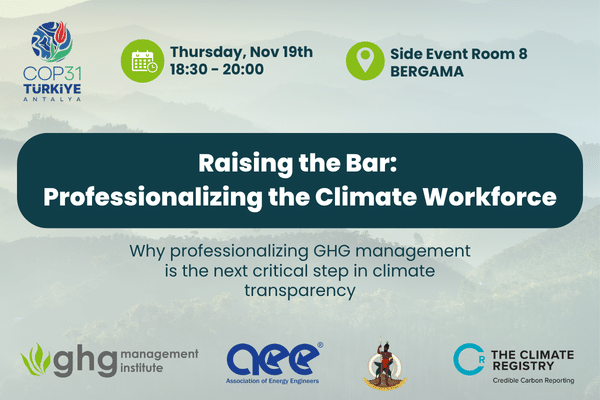
Raising the Bar: Professionalizing the Climate Workforce
Thursday, November 19th | 18:30 – 20:00 (UTC+3) | Side Event Room 8: BERGAMA
Can the climate transparency community rise to the challenge? Hear from public and private capacity-building leaders on why professionalizing GHG management is the next critical step in climate transparency and accelerating implementation. Speakers include experts from the Greenhouse Gas Management Institute (GHGMI), Association of Energy Engineers (AEE), the Government of Vanuatu, The Climate Registry, and more. Moderated by Ash Merscher, GHGMI.
Organized by: GHGMI, AEE
Post-Event & Alumni Networking
Thursday, November 19th | 19:30 – 20:00 (UTC+3) | Side Event Room 8: BERGAMA
After our side event, we invite all attendees, GHGMI alumni, and GHGMI members to join us for a networking reception. We look forward to reconnecting with you (or meeting you for the first time!), hearing about your work and projects over the past year, and learning about your professional goals. This offers a wonderful opportunity to catch up with fellow alumni, build new connections, and enjoy some valuable face-to-face time with the GHGMI community.
Organized by: GHGMI, AEE
Five Years of ReCATH in Central Asia:
From climate transparency capacity to stronger national systems
Saturday, November 14th | Time TBC | Turkmenistan Pavilion
GHGMI’s Matej Gasperic will join a panel discussion to mark the fifth anniversary of the Regional Climate Action Transparency Hub (ReCATH) in Central Asia. It will highlight key achievements, lessons learned, and the vital role of regional cooperation in strengthening national climate transparency systems and supporting climate action. The discussion will draw from the experience of two ICAT-supported phases of the hub, which received technical support from GHGMI and enabled close cooperation with international partners, and will focus on countries’ priorities and capacity needs for the next two to three years. Ultimately, the event will serve as a platform for Central Asian countries to share their evolving national priorities and discuss how the hub and its international partners can support them through technical cooperation, institutional capacity building, knowledge exchange and streamlined coordination of existing and future initiatives.
Organized by: CAREC | Participation by: ICAT & GHGMI
Measuring What Matters: Demonstrating and Scaling Higher
Education’s Impacts on Climate Mitigation and Adaptation
Wednesday, November 18th | 09:00 – 10:00 (UTC+3) | Side Event Room 6, KATİP ÇELEBİ (Blue Zone)
This event will focus on measuring and scaling higher education institutions’ climate mitigation and adaptation impacts using indicators across five impact pathway dimensions: campus operations, research, education, policy engagement, and community partnerships. GHGMI’s Molly White will be joined by professionals from Emory University, The Chinese University of Hong Kong, and the Institute of Public & Environmental Affairs. Catch her remarks at the start of the event.
Organized by: The Chinese University of Hong Kong
Regional Hubs for Climate Action Transparency:
Empowering climate action through regional transparency hubs
Wednesday, November 18th | 09:30 – 10:15 (UTC+3) | Canada Pavilion
Facilitated by our very own Molly White, this panel discussion will highlight how ICAT’s Regional Climate Action Transparency Hubs in Central Africa, Central America, and Central Asia are strengthening countries’ capacity to implement the Paris Agreement’s Enhanced Transparency Framework and support evidence-based climate action. Through regional collaboration, peer learning, and technical capacity-building, the Hubs help countries develop, implement, and track progress on their Nationally Determined Contributions (NDCs). The discussion will showcase key achievements, lessons learned, and practical approaches to overcoming institutional and technical challenges while building long-term regional expertise. GHGMI is the implementing partner for both the Central America and Central Asia hubs.
Organized by: Initiative for Climate Transparency Action (ICAT)
If you'd like to meet with GHGMI staff at COP31 in Antalya, Türkiye, please complete this request form, and we'll do our best to arrange a time.COP31 Meeting Request
Comments