
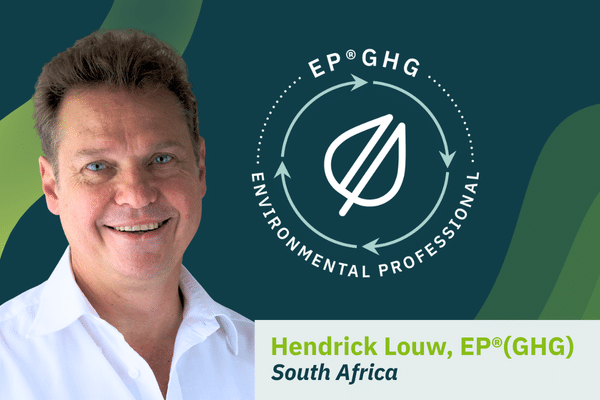
 Hendrik Louw of South Africa spent his early career on the floor of metals and mining operations, working as a chemical engineer long before “carbon management” was a job title. Twenty-six years later, that operational grounding has carried him into the first cohort of professionals certified under the EP®(GHG), the new global credential for greenhouse gas (GHG) management practitioners developed by GHGMI and ECO Foundation. Five others have received the EPt(GHG), the in-training option for early-career professionals.
Louw’s path into climate work started with a shift in focus rather than a change in field. After years inside industrial facilities, he pursued an M.Sc. in Environmental Management and Analysis, a decision that redirected his engineering background toward environmental management. When retrenchments hit the paper industry where he was working, he made the leap to independent consulting, a role he has held ever since.
That combination, industrial fluency paired with environmental training, has shaped the kind of work Louw takes on. He contributed to the development of the GHG Protocol for Aluminum and the ISO 19870 series, which sets methodology for calculating emissions across the hydrogen supply chain. He also led updates to South Africa’s national GHG Inventory, first for the Energy sector in 2022, then for Industrial Processes and Product Use in 2024. Between standards work and national reporting, he has trained companies and fellow consultants on GHG accounting, reporting, and verification, work that put him in regular contact with government agencies and gave him a wide view of the stakeholders climate policy has to serve.
Today, Louw works across several consultancies as a climate change specialist. His focus spans carbon footprinting, carbon strategy, emissions reporting, validation and verification, and climate-related financial disclosures under IFRS S2. He also holds a Diploma in Carbon Management from GHGMI.
Why Certification, After 26 Years
Louw didn’t need a credential to prove his experience. That’s part of what makes his decision to pursue the EP®(GHG) worth noting. The designation, built jointly by GHGMI and ECO Foundation and aligned with the ISO 17024 standard for personnel certification, was created to give the GHG profession something it has long lacked: a consistent, verifiable benchmark for individual practitioners, not just the organizations they work for.
For Louw, applying came down to accountability. He has described the field as reaching a point where practitioners need a mechanism that keeps them current, one that pushes them to maintain their knowledge rather than simply rely on past work. It’s a standard he sees as owed to clients and to the profession as much as to himself.
He first encountered the EP®(GHG) through an introductory webinar, then followed the certification through GHGMI and ECO Foundation’s Open House Q&A series, where he joined the conversation as a newly certified professional to talk through the application process with others considering it.
What the EP®(GHG) Signals
The EP®(GHG) is built for practitioners who already have a foothold in the field: a minimum of three years of GHG-related work, a relevant degree or additional work experience in place of one, at least 24 hours of approved GHG training, and a documented work log covering real project experience. Applicants also sit for an exam and agree to an ethics commitment, then maintain the credential through ongoing professional development.
Louw’s certification puts a name to what the designation is meant to do: recognize the practitioners already doing the technical, high-stakes work of measuring and managing emissions, and give them a credential that travels with them across employers, sectors, and borders.
Apply for the EP®(GHG)
Practitioners with hands-on GHG experience, whether in inventories, verification, project development, or climate finance, can apply for the EP®(GHG) or the entry-level EPt(GHG) through ECO Foundation.
Comments