May
10

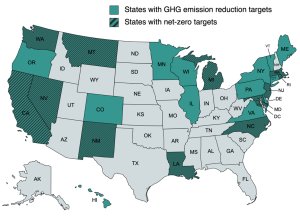
Last month, carbon market practitioners and observers gathered in San Francisco for the annual Navigating the American Carbon World (NACW) conference. NACW began in California over a decade ago as a regional meet-up for the nascent community of practice working on voluntary carbon management initiatives. Now, in step with California’s climate leadership and the start of the second shift in North American policy attention from top-down federal efforts to bottom-up state/regional action, the conference’s relevance far exceeds Golden State’s borders. Notably, this year’s NACW convened just four months following the formal start of California’s long-awaited cap-and-trade program, the world’s second largest carbon market.

Read More»

Mar
28

There is a small but growing literature that considers the challenge of climate change through the ethicist’s lens. So-called “climate ethics” addresses the ethical imperative for action on climate change. (See this short interview for a good introduction to the flavor of the discourse.) This discussion is important, but while the broad issue of climate change is analyzed at a macro-level, there is a separate litany of ethical questions relevant to those working on the ground to design and implement climate programs and policies.

Read More»

Feb
26

Electrons flowing down a wire. How many times have you heard this description in discussions on how electric power grids functions? Our greenhouse gas (GHG) accounting framework for indirect emissions from purchased electricity (i.e., Scope 2) is built around this mental model — the idea that electrons in the electric grid are analogous to water or natural gas in a pipe where we just replace molecules with electrons. Indeed, it is hard to find a reference in our field on the topic of indirect emissions that does not lean on or allude to this description of the physics of electricity.

Well, in the spirit of earlier semantic alerts I’ve posted on misused terminology in GHG accounting (see previous entries on “real” and “counterfactual”), in this blog post I’m going to come after another esoteric GHG-related linguistic bubble with a pointy stick.

Read More»

Jan
15

One of the more frustrating issues I deal with as an educator is the focus by many governments, NGOs, foundations, and much of the scientific community on “climate literacy” as a strategy for shifting the climate change policy debate.

Climate literacy is the label given by organizations, such as the U.S. National Science Foundation, to the work of teaching the lay public about climate science and global warming. Let’s be clear, I soundly believe that the world would be better if more people had a deeper understanding of science (perhaps starting with the reality of biological evolution through natural selection).

Read More»

Oct
25

Much of the world right now appears largely unconcerned with climate change. And, this state of affairs is just what social psychology tells us we should expect. People will avoid thinking about and accepting as real problems like climate change that feel remote and have complex long-term causes and solutions. Combine the enormous distractions of ongoing economic upheaval in many parts of the world and the quadrennial naval gazing in the United States that is the Presidential election season and it is unsurprising that the outcome is indifference to the specter of the climate problem.

Read More»

Aug
24

Continuing on the theme of widely held fundamental misconceptions in the carbon management community (see previous blog posts here and here), today I am going to write on a matter of terminology I find particularly irksome: the use of the term “counterfactual” in additionality discussions.

Read More»

Aug
3

I am about to commit an act of minor heresy by telling you that something everyone repeats as gospel is flat bunk. The qualities of a good emission offset project are one of the most common refrains you hear in the carbon offsets community. You can probably repeat most of them by memory: real, additional, permanent, verifiable, etc. Different programs or protocols might add other points about leakage or accuracy, or conservativeness or some other offset quality principle. But common to almost all programs and standards and protocols is the criterion that offset projects or credits must be “real.”

Here is a question for you: What does it mean for an offset project to be real? What would an unreal offset project be? How could we tell if it was unreal, and is this something we should be concerned about?

Read More»

Jun
25

Since the June 2011 global launch of the EP(GHG) and EPt(GHG) designations under our Professional Certification Program, in partnership with ECO Canada, we have seen an outpouring of enthusiasm from individuals and organizations alike. More than 350 individuals from all regions in the world have started the application process for the EP(GHG) and EPt(GHG) titles; a response that we have found both validating and humbling. Now that this groundbreaking GHG certification program has been launched, we would like to reaffirm our motivations and look forward to the important role professionalization will play for the future of carbon management. Admittedly, relative to the fast-changing fads in climate change policy, GHGMI’s activities in this area probably seem to you like a tortoise rather than a hare. We see just the opposite.

Read More»

May
29

You have probably experienced this situation before. You have an idea for a project that you believe is important and innovative. But you don’t have funding for it, and are not exactly sure how to accomplish it. Yet, convinced of its potential, you charge ahead anyway, expecting to plan as you go. You struggle, make progress, get frustrated, get distracted by other projects, recommit to it, and cycle through the same progression again and again. Years go by…

In our case, it has been four years. And this particular story, fortunately, has a happy ending. Today, I am pleased (and relieved) to announce the launch of our new course on GHG Accounting for Energy Efficiency Projects.

Read More»

Jan
25

If you have worked in the climate change space for very long, you have likely faced this question in one form or another. Try explaining carbon offsets to your sister-in-law and you have two choices. Either you give her a superficial response in an attempt to change the subject or you dive in and try and explain offsets. If you chose the latter, you will find it near impossible to avoid the concepts of a baseline and additionality.

Read More»

Dec
21

It’s December, a month best characterized in many parts of the world by holiday cheer, winter revelry, and reflection of the year that’s about to draw to a close. But for those following international climate negotiations, the end of the year also marks the season for another brand of reflection: deriving meaning from the annual UNFCCC Conference of the Parties.

Read More»

Oct
31

“Will failure to strike a post-Kyoto deal in Durban kill the carbon market?”

With the latest big annual United Nations climate conference just a month away in Durban, South Africa, this question is seeing attention from the press the world around. The question seems innocuous enough, but as with so much in climate policy —and particularly the UN process— answers come in pieces, with caveats, and almost exclusively in acronym-thick jargon difficult for anyone who doesn’t happen to be a full-time climate policy wonk to penetrate.

Read More»

Sep
21

It is easy to get pessimistic, if not outright depressed, in this business. After all, humanity keeps beating on the atmosphere with a sharp stick hoping that the climate will keep taking it with a smile. Meanwhile witnesses to this abuse expectantly turn to governments to intervene only to find a political horizon devoid of ambition for real change. Indeed, governments around the world seem overstretched already as they impotently struggle to calm markets and restart engines of economic development in the face of financial turmoil, the impacts of which continue to seep into and saturate the global economy. Drowned out by policy debates on economic woes and fiscal policy, climate change, it seems, rarely even makes the agenda anymore.

Read More»

Aug
25

There is no shortage of opinion on the concept and application of carbon offsets. The fervent debate these wonky mitigation instruments whip up runs an impressive multidisciplinary gamut from questions of morality to marginal cost of abatement. But while offsets have spurred a prodigious volume of discussion, there is a striking dearth of plain English analysis breaking down the complex commodities. Correspondingly there are startlingly few resources that dig beneath the veneer of marketing statements or go beyond a simple rehashing of basic concepts and statistics. In the face of this information shortfall, researchers at the Stockholm Environment Institute (SEI) have shown notable leadership. Over the past few years SEI has published a valuable catalogue of clear, accessible, and rigorous reports on the technical bits (e.g., greenhouse gas accounting and other programmatic rules) that underpin offset programs. In an effort to make this information even more user-friendly and digestible, SEI translated these materials into an interactive website: Carbon Offset Research & Education (CORE).

Read More»

Jun
30

Your response to the launch of the EP(GHG) professional certification over the last three weeks has been tremendous, confident, and unequivocal. Indeed, the reaction from the international GHG community has obliterated even our most ambitious expectations. Professional certification is the capstone initiative under our mission as a non-profit organization. Therefore, we want to say thank you those of you that have already expressed your support. (If you would like to add you voice to the list of supporters email us at: info@epghg.org. We will be excerpting some of these responses in future dispatches.)

Read More»

Jun
7

The Greenhouse Gas Management Institute is elated to today announce that it has partnered with the Environmental Careers Organization of Canada (ECO Canada) to launch a groundbreaking new professional certification for GHG practitioners: the EP(GHG).

If you’re curious about the specifics of what the EP(GHG) entails, the press release announcing this new certification is provided below and further information is available at www.epghg.org. But first, we’d like to take this opportunity to provide some background on how this new professional certification fits into the broader need for professionalization across GHG measurement, reporting, verification (MRV), and carbon management.

Read More»

May
19

I think we all realize that eventually governments and society will reach a point of dramatic transition characterized by the implementation of serious measures to address climate change. Indeed, the question today is not whether this transition will happen, but when and how. As we so often say, it is our mission at the GHG Management Institute to help build the capacity to prepare for and enable this transition to occur.

Our focus is on you, the professional class that will make up the human resource infrastructure upon which this transition is built. To date, our discipline has lacked a key institution common to almost every other field of professional practice: a credible and well-recognized personnel certification. We have been working towards this objective, which we see as the pinnacle of professionalization, since the inception of the GHG Management Institute. In doing so, we have consciously chosen the slow and deliberate path, focusing on quality rather than speed because ultimately the success of a professional certification is dependent on its credibility.

Read More»

Apr
12

Here’s a test to see how long you’ve been part of the GHG expert community: Do you remember the old GHG Experts Network?

If the answer is yes, then I have good news for you, the Institute is recreating the old Experts Network listserv as a part of our membership program. Of course this is good news even if you’ve never heard of the GHG Experts Network, but it’s exciting to finally have a resource to point the “old timers” who have for years been asking what happened to the GHG Experts Network listserv.

Read More»

Mar
24

The professional lexicon of climate policy has an air of maturity. Melding climate science terminology, esoteric domain concepts, and countless three letter acronyms (TLAs), carbon wonks are known to dialogue in an inaccessible jargon so rich it may, to the uninitiated, appear to border on another language. Yes, by this hollow measure, climate policy would seem to have the trappings of more established professional fields. Yet, a cursory look at the definitions associated with carbon’s work bank rather nakedly underscores our discipline’s immaturity. Nowhere in climate policy is language and definition more confused than the concept of additionality.

Read More»

Mar
10

For the climate policy news junkies and carbon geeks that follow greenhouse gas reporting for work or (sadistic?) pleasure, the last few weeks have seen a particularly high churn of new developments. It’s hardly news that the new U.S. Congress isn’t terribly keen on continuing to classify GHGs as pollutants. Likewise, new decisions from the European Commission on the EU Emission Trading Scheme may not please participants and environmental watchdogs alike, but its movements and process are at least well understood.

Read More»